
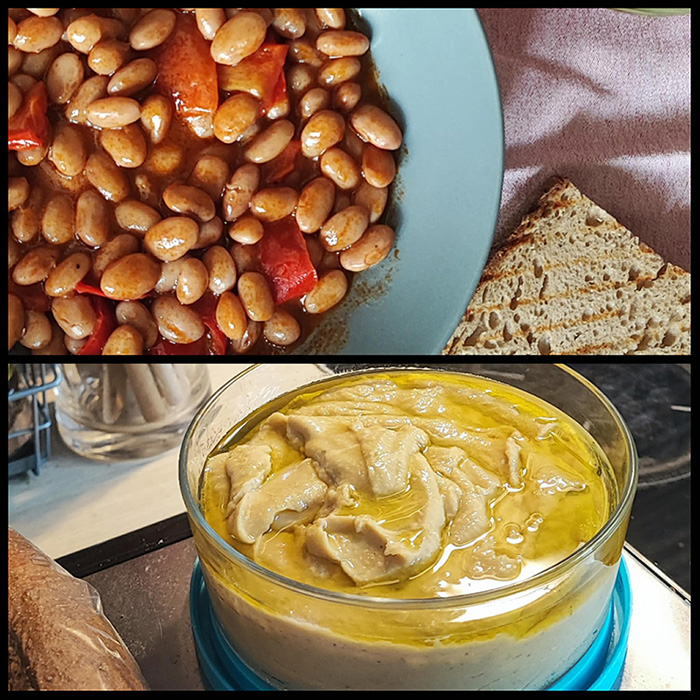
Some of the most beloved Greek recipes were never created with the intention of being vegan.
They were not designed to replace anything or prove a point. They simply came from a time when pulses, vegetables, extra virgin olive oil and fresh herbs formed the heart of everyday Greek cooking.
That is why we can still enjoy dishes such as tomato-braised beans and silky Greek fava today without needing to change much, if anything, from their traditional preparation.
It is one of the things I love most about Greek cuisine.
We do not always need to “veganise” a recipe. Sometimes, we simply need to remember the naturally plant-based dishes our grandmothers were already cooking.
Today, I am sharing two recipes that appear again and again in our kitchen: a comforting pot of Greek cranberry beans cooked in a rich tomato sauce and a quick, velvety Greek fava spread that we use in almost everything.
Greek Cranberry Bean Stew – Fresh “Handres” in Tomato Sauce
Every summer, I wait for fresh cranberry beans to appear at my local farmers’ market.
In Greece, we often call them handres, meaning “beads”, because of their beautiful speckled appearance. They are also widely known as borlotti beans, particularly in Britain and other parts of Europe.
I remove the beans from their pods, place them in the freezer and keep them there so that I can enjoy them long after summer has ended.
Because they are frozen while fresh, I cook them directly from the freezer. They do not need soaking, and I usually do not need to boil them separately or discard their cooking water.
An easy plant protein boost
I often add a handful of these beans to my tomato sauce for pasta. It is a simple way to add more plant protein, texture and substance to an everyday meal without preparing a separate dish.
How I cook the beans
I begin by placing the beans in a saucepan with extra virgin olive oil, tomato purée, salt, black pepper and an onion.
I cook everything gently over a medium heat so that the beans and vegetables begin to absorb the flavour of the olive oil and tomato.
Most of the time, I do not even chop the onion. I simply add it whole, allow it to flavour the sauce as the beans cook and remove it at the end if I wish.
During the summer, I always add a finely chopped Florina pepper as well.
Florina peppers are sweet red peppers grown in Greece, and their deep natural sweetness works beautifully with the tomato sauce and the earthy flavour of the beans. A sweet red pepper is a perfectly good alternative if Florina peppers are not available where you live.
If I have some in the freezer, I also add a little finely chopped celery.
This dish needs a touch of greenery!
I then add enough water to cover the ingredients. Warm or freshly boiled water helps the cooking process begin a little more quickly.
I bring the pot to a stronger boil for approximately five minutes, then lower the heat and allow the beans to simmer gently over a medium-low heat.
I leave them to cook until they are completely tender and the tomato sauce has thickened naturally around them.
If the liquid reduces too quickly, I add a little more warm water. I do this gradually, however, because the finished dish should not be watery like a soup.
The aim is a rich, thick sauce that coats the beans beautifully.
A little cooking tip
As with many slow-cooked dishes, these beans often taste even better the following day, once the tomato, olive oil and vegetables have had time to settle and their flavours have fully blended.
How we serve them
Although this is a warm and comforting dish, it is also lovely served at room temperature, particularly during the summer.
I usually serve the beans with vegan white cheese, a fresh seasonal salad and thick slices of wholemeal bread to soak up every last drop of the sauce.
It is simple, homely food, but it is also deeply satisfying and full of the flavours I associate with a Greek summer kitchen.
Velvety Greek Fava Spread
Very often, while the larger saucepan is bubbling away, I place my small saucepan next to it and make a batch of velvety Greek fava spread.
Greek fava is one of the most traditional dishes of the Cycladic islands. Despite its name, it is not usually made with broad beans or what English speakers commonly call fava beans.
Traditional Greek fava is made from yellow split peas, which cook down into a wonderfully smooth and creamy purée.
We have fully embraced it in our vegan diet and use it in many different ways.
It has become our favourite 100% homemade spread for toast, sandwiches, crackers, vegetable sticks, salads and grain bowls.
Because it is made at home, I know exactly what goes into it. There are no artificial preservatives, unnecessary additives or mystery ingredients often found in heavily processed shop-bought spreads.
It contains only yellow split peas, fresh lemon juice, extra virgin olive oil, salt and black pepper.
Why I love making Greek fava
One of the best things about yellow split peas is that they do not require soaking.
The same is true of red lentils, which I also use to make a quick and delicious homemade spread.
This means that whenever we need something nourishing for breakfast, lunchboxes or sandwiches, I can prepare a batch without planning hours in advance.
In only a few minutes, you have a filling, naturally vegan spread that is rich in plant protein and made entirely from simple ingredients.
How I make my fava spread
I place 200 to 300 grams of yellow split peas in a small saucepan and add just enough water to cover them.
I bring them to the boil over a high heat for approximately three to four minutes.
I then lower the heat and allow them to simmer gently.
They need a little attention while cooking. I stir them from time to time so that they do not stick to the bottom of the saucepan, and I keep an eye on them because the mixture can foam and rise as it cooks.
The exact cooking time may vary slightly depending on the split peas and the amount of water, but mine usually soften and thicken in around ten minutes.
If they absorb all the liquid before becoming completely tender, I add a very small amount of warm water and continue cooking.
Once the split peas have softened and formed a thick purée, I add plenty of freshly squeezed lemon juice, extra virgin olive oil, salt and freshly ground black pepper.
I then blend the mixture with a hand blender while it is still warm.
Blending it warm helps it become light, smooth and wonderfully velvety.
The result is a traditional Greek spread that is creamy, wholesome and versatile enough to go almost anywhere.
Tip for the perfect texture
Greek fava continues to thicken as it cools. If you prefer a looser, creamier consistency, add a little more lemon juice, olive oil or a teaspoon of warm water and blend or stir it again.
How I store it
I transfer the finished fava spread to a clean glass container and allow it to cool completely.
Once cool, I cover it and store it in the fridge for two to three days.
We spread it on toast in the morning, add it to sandwiches, serve it as a dip or spoon it over salads and bowls.
It is one of those simple homemade staples that makes everyday meals easier, healthier and far more interesting.
The Beauty of Simple, Homemade Greek Food
I do not believe that good food needs dozens of ingredients or complicated cooking techniques.
Sometimes, all you need is a few good-quality ingredients, generous extra virgin olive oil and a little patience while the food simmers gently on the hob.
Perhaps that is why I return to recipes like these again and again.
They are affordable, nourishing, filling, rich in plant protein and full of flavour.
Most importantly, they are not trying to imitate anything else.
They are authentic Greek dishes that have been enjoyed for generations and remind us that some of the simplest food is often the most delicious.
Enjoy the recipes, and I hope they bring a little taste of a Greek home kitchen to your table!
Watch the Recipes in Action
Would you like to see how I prepare the Greek cranberry bean stew and velvety fava spread in my kitchen?
Watch the short video below to see both recipes coming together.
Two naturally vegan Greek recipes, made simply in my home kitchen.